
Does film make a worthwhile difference?
Yes. Security window film can help slow entry through broken glass when it is properly specified, installed and attached.
The International Window Film Association identifies this as a forced-entry benefit. IWFA safety and security guidance.
For your family, the value is the resistance that remains after a pane breaks. More resistance can mean more opportunity to recognise what is happening, seek help or move away from the affected area.
That is why Clear Guard recommends XPEL Security Clear 14 mil with DOWSIL 995 frame attachment for suitable residential glass.
You are buying a stronger barrier at an accessible window, with the installation designed around its glass and frame.
No film makes glass unbreakable or guarantees that entry will be prevented. The useful question is whether the proposed installation addresses the glass and access points that concern you most.
What changes after the glass breaks?
Security film bonds to the glass and helps hold broken fragments together. Instead of depending on an intact pane alone, the filmed pane resists separation and penetration after breakage. IWFA guidance.
The film, its connection to the frame and the frame itself work together. Film stuck to glass does not automatically mean that the damaged pane is anchored to its surroundings.
For a patio door near a family room, or an accessible bedroom window, that distinction matters. Your concern is the entry path someone could create through broken glass.
The assessment should address that window, rather than simply quote a film thickness.
Our visual guide to how security window film works explains the mechanism in more detail.
Why we recommend XPEL 14 mil
XPEL Security Clear 14 mil PS, product code XVSC14M, has a nominal puncture-resistance figure of 230 lb. XPEL 14 mil specification, section 2.2; XPEL product identification, R0326V3.
Puncture resistance is relevant because a concentrated force acts against the film material when someone tries to penetrate it.
We consider that material strength alongside the glass, frame and attachment when recommending an installation for your home.
This product is intended for the interior glass surface.
If the job needs a different installation position, the proposal should identify the appropriate product rather than assume the same 14 mil film suits every application. XPEL specification, section 1.1.
Why DOWSIL 995 attachment belongs in the proposal
DOWSIL 995 provides the connection between the filmed glass and a suitable frame. Dow identifies this structural silicone for anchoring retrofit protective window film to window frames. Dow protective-glazing brochure, page 6.
Clear Guard assesses the available frame surface, its condition and compatibility before specifying that connection. Preparation, attachment design and curing follow the applicable manufacturer instructions.
XPEL's installation specification describes a wet-glaze attachment system and recommends compatibility testing. XPEL specification, section 3.5.
Your written proposal should name both the film and the attachment. That makes the intended barrier clear before installation.
Which windows should you consider first?
Start with glass that is accessible from outside, then consider the room it serves and the surrounding frame. This is a per-window decision; the same treatment need not be the right priority everywhere.
| Part of the home | Useful assessment question |
|---|---|
| Patio-door or ground-floor glass | Can film and attachment add resistance at this accessible window? |
| Glass beside a door | What glass, latch position and frame condition need to be considered together? |
| Basement window | How accessible is it, and is the glass/frame suitable for the proposed installation? |
| Upper-floor window | Is there practical outside access that makes it a priority for this home? |
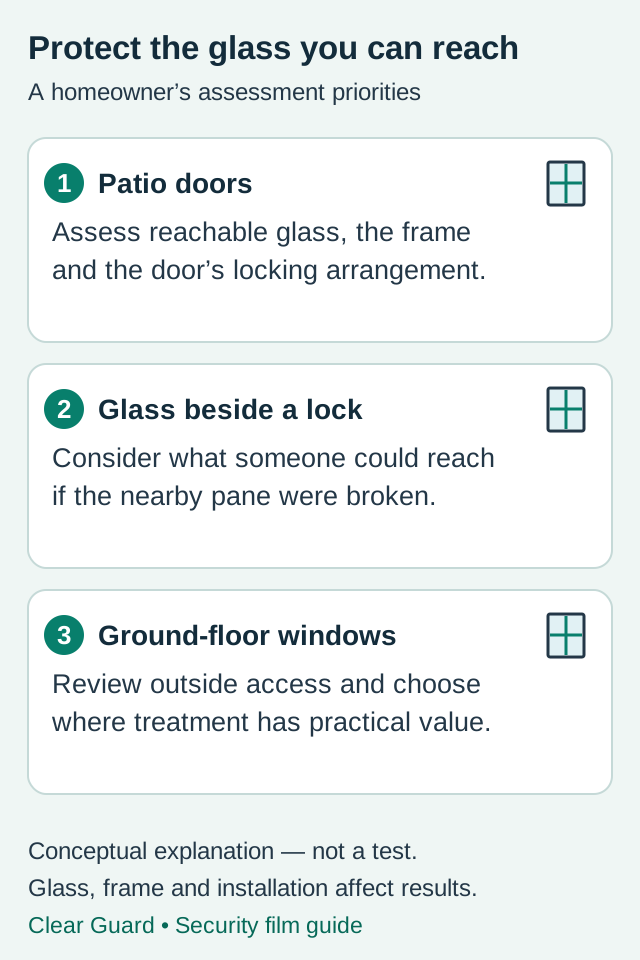
If the door or its frame needs attention, include that in the same discussion. Window film protects the glass portion of the home; door security addresses the door and its frame.
How film complements an alarm
An alarm can detect and report an event through its configured sensors and notification arrangements. Film adds physical resistance at the glass.
Those roles complement each other: knowing something is happening and making access harder are both useful.
The aim is more opportunity for your household to respond, rather than a promised number of minutes. Neither a material specification nor an alarm subscription determines when help will arrive.
Turn the concern into a window-by-window plan
A free Clear Guard assessment can identify suitable glass, explain frame attachment and prioritise the windows that matter to your household. Ask for the exact film, attachment scope and installation requirements in your written quote.
Planning work in Markham, Brampton or Newmarket? Review the local service page for assessment scope and property-coordination questions before booking.
See our security window film service, thickness guide and XPEL warranty information before deciding. Warranty coverage is a separate question from forced-entry resistance.
Specification note
Sources reviewed October 7, 2026.
The puncture figure describes a nominal material property, not a measured entry delay for your window. Actual resistance depends on the glass, frame, attachment, installation and loading.
The primary sources linked above support the material and attachment choices; they do not promise a fixed household response time.